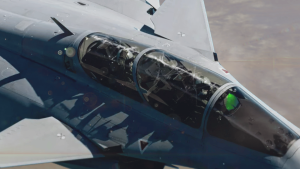
More information about Canopy Severance or Fracturing systems
See more detailsDid you know that fighter aircraft canopies must be extremely durable to withstand several types of threats.
Fighter aircraft canopies must be extremely durable to withstand several types of threats.
They must withstand:
- a bird strike, with the current standard being to withstand the impact of a 1.8 to 4 kg bird flying at 500 knots, or nearly 1,000 km/h!
- differential pressures at altitude and aerodynamic forces associated with extreme maneuvers (accelerations of 9G or more).
They must also most often provide ballistic protection, requiring them to withstand small-caliber ammunition (7.62 mm or even 12.7 mm).
Fighter aircraft canopies are also made of materials that offer excellent optical transparency while being scratch and impact resistant. These materials are generally polycarbonate, a transparent plastic material, or acrylic (PMMA), also known as Plexiglas. They are also lightweight, which is essential for the aircraft’s aerodynamics and performance. They can be laminated and sometimes reinforced with layers of composite materials, special treatments, or anti-splinter films to withstand enemy fire.
Canopy thickness
Canopy thickness varies, but is generally in the range of a few millimeters to a few centimeters. Thickness can vary at different points along the canopy to meet structural strength and protection requirements. For example, the front portion of the canopy may be thicker than the side portions to withstand potential impacts (typically ~40 mm frontal and ~20 mm lateral).
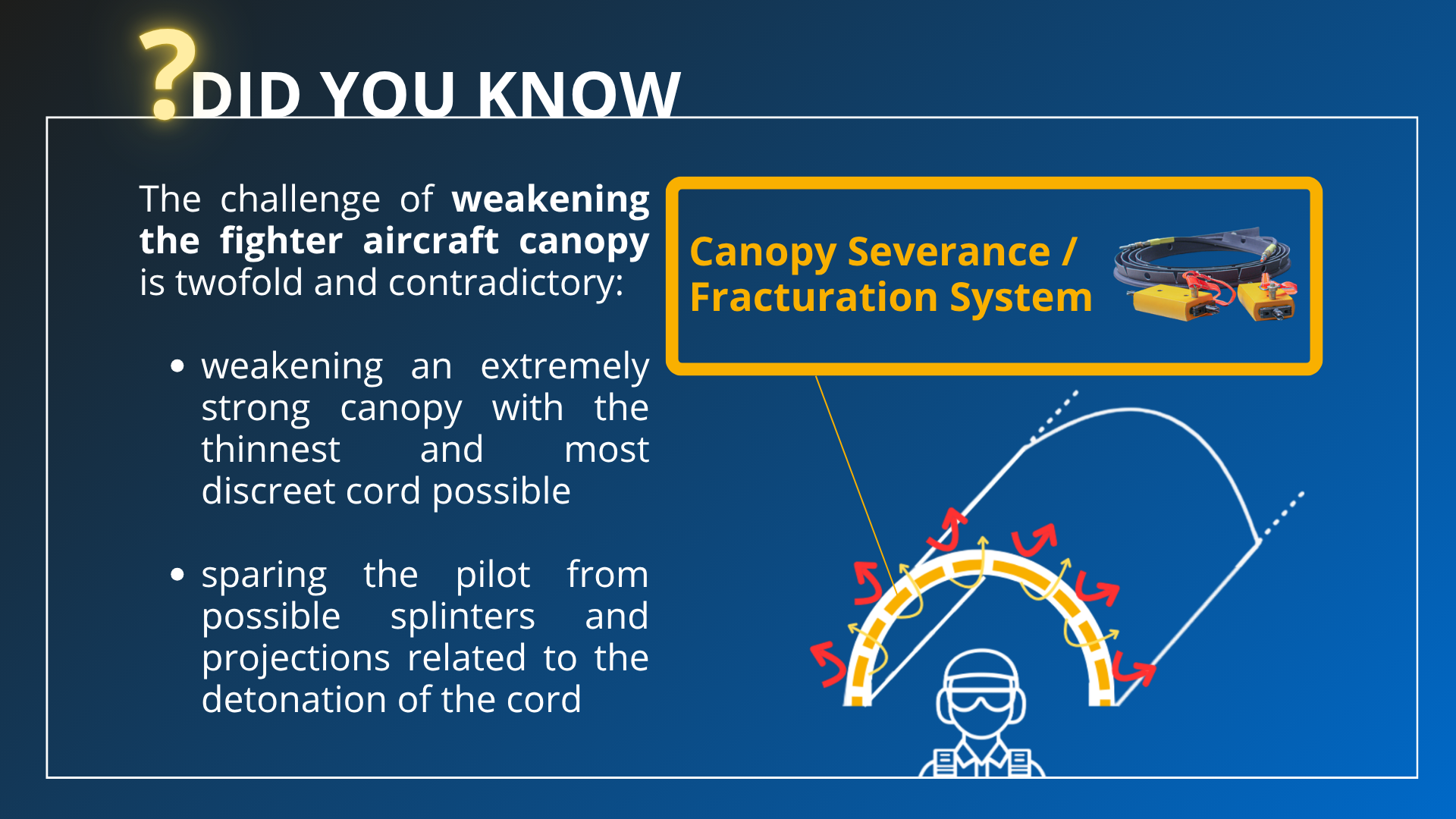
The challenge of weakening the canopy is twofold and contradictory:
- it involves – see above – weakening an extremely strong canopy with the thinnest and most discreet cord possible
- while sparing the pilot – already in a situation of proven danger – the risk associated with possible splinters and projections caused by the detonation of the cord
The solutions implemented by aircraft manufacturers and their pyrotechnic equipment suppliers to resolve this challenge vary and are the subject of closely guarded secrets, as pilot safety is a major issue for any manufacturer of military aircraft!