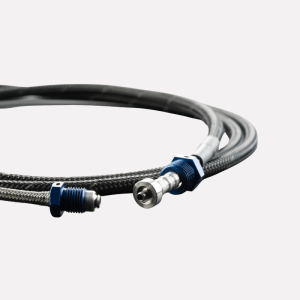
More information about Deflagrating Transfer line
View product detailsSignal transmission in missiles for Defense - by Simon
Expertises and Technologies
01.11.2025
(09-22-2023) - Strengths of Pyrotechnics for defense critical missions : how do pyrotechnic transfer lines fit with missile technical issues
How is pyrotechnic transmission adapted to complex missile architectures?
Pyrotechnic transfer lines are used to propagate a command signal down to a terminal function whether engine or actuator for instance.
This requires finding a way through a possibly winding path.
Pyrotechnic transfer lines are designed to ensure mechanical robustness and flexibility which are two key features to facilitate equipment’s integration into the most complex missile architectures.
Pyrotechnic lines can also be declined in very low modules.
And those extremely thin diameters enable to fit in extremely compact architectures.
How do pyrotechnic transfer lines secure the interface with other equipment?
Pyrotechnic lines can be “plugged” to several kinds of inputs whether a mechanical striker, a detonator, or a slapper
… for example as well as different kinds of downstream terminal functions like an engine igniter or a pyromechanism.
This kind of “plug and play technology” is made possible by the ability to propose “tailored end tips” adapted to many different configurations.
A range of pyrotechnic lines
Depending on those interfacing equipments, pyrotechnic lines have to be adapted as well to the quantity of energy needed by the receiver for its own initiation.
That’s why we have a range of pyrotechnic lines from detonating to deflagrating technology.
The output signal can even be amplified through the addition of a relay, incorporated into the line end tips.
How do pyrotechnic transmission lines contribute to the reliability of the mission?
A major stake for the mission success is the resistance to severe environments and the control of undesired external effects.
Transmission lines are designed with external envelopes that act as a bi-directional protection barrier.
It means, they are sheathed and braided with different layers of protection so as to transmit the signal with an absolute reliability, in spite of severe external environments.
And at the same time, the tightness of this “envelop” prevents any leakage or external effects during operation and ensure the lines will not cause any damage on the neighbouring equipment.