Canopy severance and fracturing: when pyrotechnics save lives
03.06.2026
When a crew must leave their aircraft in an emergency, one obstacle stands between them and the outside: the canopy. Depending on whether the evacuation happens by in-flight ejection or by egress on the ground, two distinct pyrotechnic solutions meet the need — canopy severance and canopy fracturing. Pyroalliance designs and manufactures the devices that equip combat and training aircraft, from the single detonating cord to the complete pyrotechnic chain.
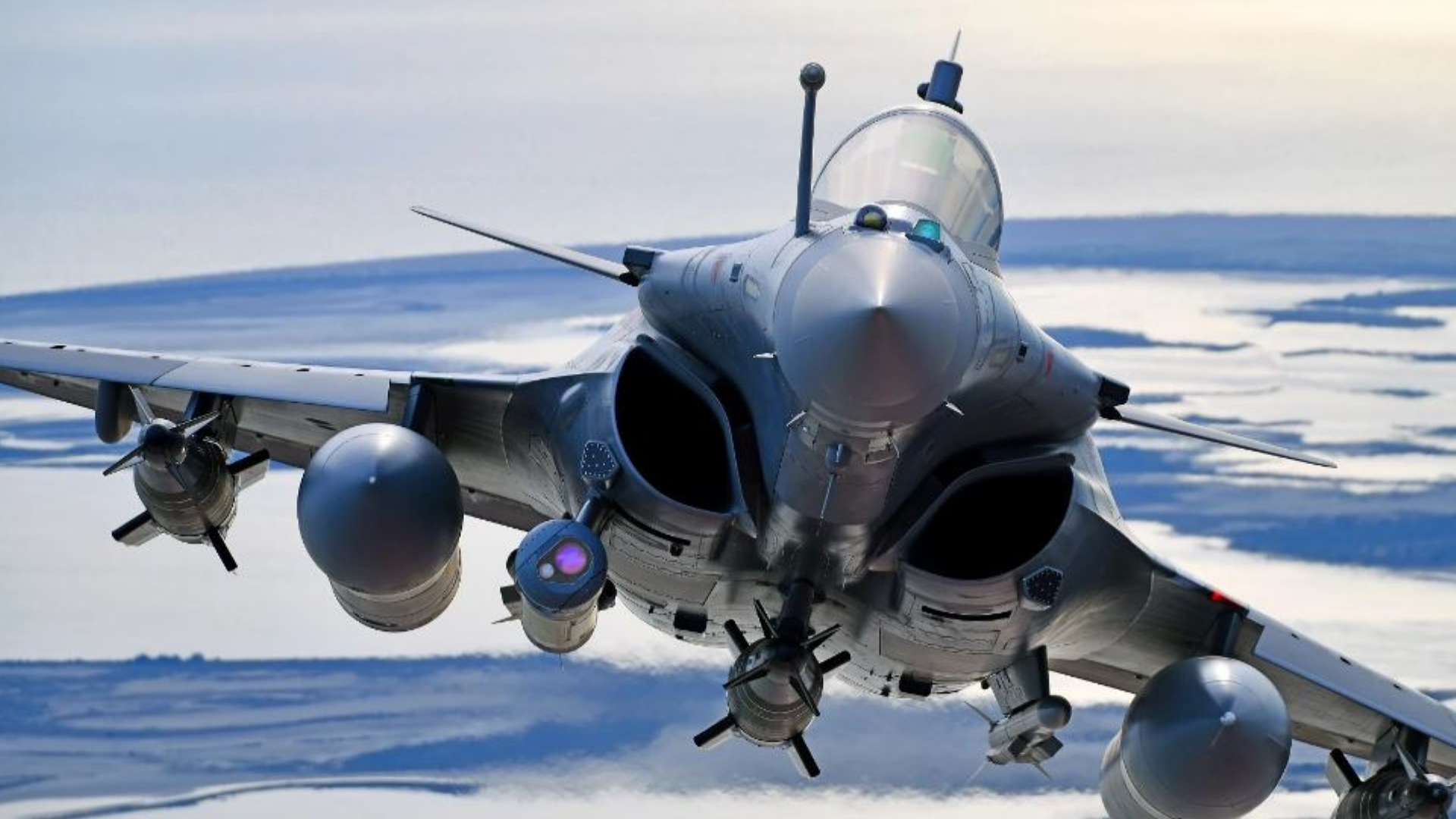
Canopy severance and fracturing: when pyrotechnics save lives
Evacuating a combat aircraft is often imagined as a single action: pull a handle, and everything follows. The reality is more nuanced. There are in fact two main emergency-egress scenarios, which place different demands on the canopy.
- In the first, the pilot is ejected in flight by a seat that propels them through the canopy.
- In the second, the aircraft is on the ground and the crew exits under their own power.
These two scenarios correspond to two different pyrotechnic functions, and to two distinct levels of supply at Pyroalliance.
It is this distinction that we explore here.
1. The canopy, the last obstacle before egress
On combat and training aircraft, the canopy is a solid structural component, designed to withstand high speeds and impacts such as bird strikes. This robustness, essential in normal flight, becomes a problem in an emergency: this transparent barrier must be cleared instantly and with complete reliability, without injuring the pilot.
To achieve this, the military aerospace industry relies on detonating cords: flexible linear charges bonded to the inner face of the canopy along an engineered path. When the pyrotechnic chain is initiated, the detonation wave runs along the cord and breaks the canopy along the defined line, in a few milliseconds. The principle is common to the two functions that follow — but their use, their scenario and the scope supplied by Pyroalliance differ significantly.
There is also another approach, complete canopy jettison, which ejects the canopy as a single unit before the crew exits; it relies on a different technology and falls outside the scope of this article, which focuses on detonating-cord solutions.
The distinction we are concerned with lies in when and how the crew leaves the aircraft:
- In-flight ejection on one hand,
- Ground egress on the other.
The next two sections describe each of these cases.
Zoom on a fighter jet canopy
2. Severance: clearing the canopy in flight during ejection
Severance corresponds to the in-flight ejection scenario.
The ejection seat propels the pilot upwards; so that the canopy does not act as a wall, it is first weakened by a detonating cord that breaks it along the seat’s path. The pilot then passes through an already-broken canopy, which sharply reduces the loads at the moment of pass-through.
In this case, Pyroalliance supplies only the detonating cord.
The rest of the chain:
INITIATION > SEQUENCING > LINK TO THE EJECTION SEAT
belongs to the ejection architecture implemented by the aircraft manufacturer or the seat integrator. The Pyroalliance cord thus fits in as a specialized link within a larger system, whose overall design responsibility lies elsewhere.
This narrower scope is no less demanding: the cords specific to this application must deliver perfectly controlled, repeatable severance across the entire temperature range and after years of waiting on board, without ever weakening the canopy inadvertently in normal service. This is where component qualification — STANAG 2895 compliance, resistance to shocks & vibrations, UV and crash — takes on its full importance.
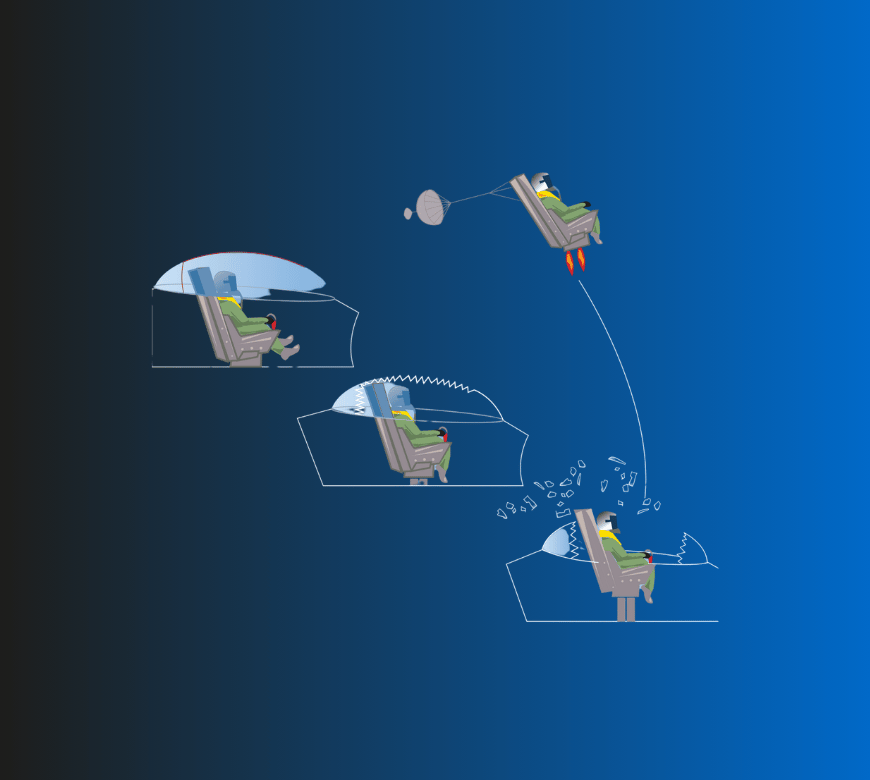
Illustration of a fighter plane canopy severance for the pilot’s ejection
3. Fracturing: breaking the canopy on the ground without ejection
Fracturing corresponds to the ground-egress scenario, without actuating an ejection seat.
The aircraft is on the ground, and the crew must be able to exit quickly under their own power — for instance if normal opening of the canopy is impossible. Pyrotechnics then breaks the canopy around its entire perimeter to clear the opening needed for egress.
In this case, Pyroalliance supplies not a single component but the complete pyrotechnic chain:
- the control unit,
- the transmission line over typically more than 8 metres,
- the fracturing cord shaped to fit the geometry of the canopy.
Here the company is the prime contractor for the entire Fracturing Canopy System, designed and manufactured under its own design authority.
The system is triggered by mechanical action from the pilot and remains fully autonomous: it requires no external energy, neither electrical nor hydraulic. This independence is valuable for a ground evacuation, where onboard energy sources may be unavailable. The part installed in the cabin is moreover optimized to avoid any effect on the crew or the rescue teams: contained effects, no fragments or flames near the crew.
Configurations adapt to the aircraft profile. On a two-seat aircraft, two chains equip the platform — a front one for the pilot, a rear one for the copilot — each of which can be operated by either occupant. Dimensions, weight and delivered energy (the SWaP set: Size, Weight and Power) are tailored to each program’s specification. The absence of ITAR restrictions facilitates export procedures.
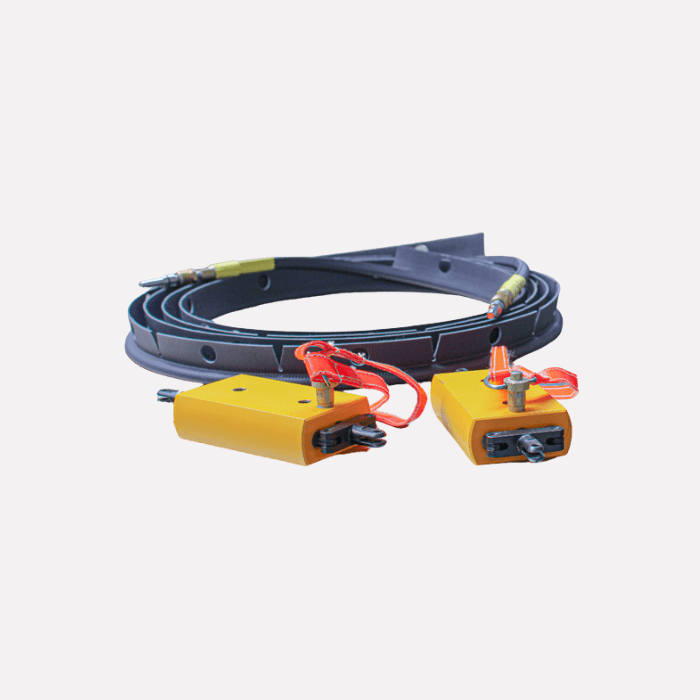
Canopy fracturing System – ©Pyroalliance
4. The added value of pyrotechnics
Whether Pyroalliance supplies a cord alone or a complete chain, the choice of pyrotechnics always rests on the same fundamental reasons — a set of characteristics that only this technology combines in a single device.
Speed:
A pyrotechnic charge delivers its energy in a few milliseconds. In an ejection sequence as in an emergency evacuation, this response time is decisive: no solenoid, hydraulic actuator or electric motor competes on this parameter.
Energy autonomy:
A pyrotechnic system carries its own energy. It depends neither on the aircraft battery, nor on the hydraulic circuit, nor on any external source. This independence is vital in an emergency — precisely when other onboard energy sources may fail.
Long-term reliability:
Pyrotechnic components contain no moving parts that could wear, seize or drift over time. Correctly stored and qualified, they remain dormant for years before performing exactly as expected the day they are called upon. Integrating redundancy in the chain pushes the reliability level to a standard that other technologies struggle to match.
On top of these generic qualities come those of the Pyroalliance design:
- Tailoring to the aircraft design,
- Contained effects,
- Direct mechanical triggering,
- Order transmission,
- A wide temperature range,
- Excellent UV resistance,
- Resistance to vibration and crash,
- And a service life compliant with the STANAG 2895 standard.
So many strengths that apply equally to the cord alone and to the complete chain.
Severance and fracturing address two clearly distinct scenarios:
- In-flight ejection on one hand,
- Ground egress on the other.
In both cases, the same requirement applies: a critical, irreversible function that must be executed flawlessly the very first time it is called upon, sometimes after years of silent dormancy.
This is precisely what aerospace pyrotechnics make possible, and what Pyroalliance places at the service of military aircraft manufacturers.